Can you have a home battery without solar?
You can have a home battery without solar, and for many New England homes it is the more practical choice. The battery simply charges from the grid.
Most home battery marketing assumes panels on the roof, because most home batteries are sold by solar companies. A lot of large homes around Boston, on the Cape and in Newport don’t have a good roof for solar. Some sit in historic districts. Some are shaded by old trees. Some owners just don’t want panels. None of that should rule out backup power.
| Setup | Runs in an outage? | Protects equipment daily? | Recharges from |
|---|---|---|---|
| Grid-tied solar, no battery | No, it shuts down with the grid | No | Not applicable |
| Storage battery with solar | Yes, for its stored energy | Not its job, per RoseWater | Solar and grid |
| RoseWater HUB, no solar | Yes, with zero transfer time | Yes, always online | Grid, or a generator in an outage |
| RoseWater HUB with solar | Yes, with zero transfer time | Yes, always online | Solar up to 10 kW, grid, generator |
How does a battery recharge without solar panels?
A battery without solar recharges from grid power whenever the grid is up. You don’t have to do anything. The system keeps the batteries full on its own.
In a RoseWater HUB, rectifiers are used only to charge the batteries, and the inverter modules handle the conditioning. After an outage, the HUB refills the batteries from the grid while it goes on cleaning the power. If the outage is long and you have a generator, the generator can carry the house and recharge the batteries, and the HUB conditions the generator’s output the same way it conditions the grid’s. Our guide to pairing a generator with a battery system explains how the two share an outage.
Does solar work when the grid goes down?
Grid-tied solar without a battery does not work when the grid goes down. The inverter shuts the array off so it can’t send power back onto lines that utility crews may be working on.
That surprises a lot of owners the first time the power goes out on a sunny day. RoseWater makes the same point: solar alone is not backup. Solar only keeps a house running in an outage when it is paired with a battery system that can run the home on its own. That is one reason to start with the battery. The battery is what keeps the house running, and the solar is a way to refill it.
Can I add solar later?
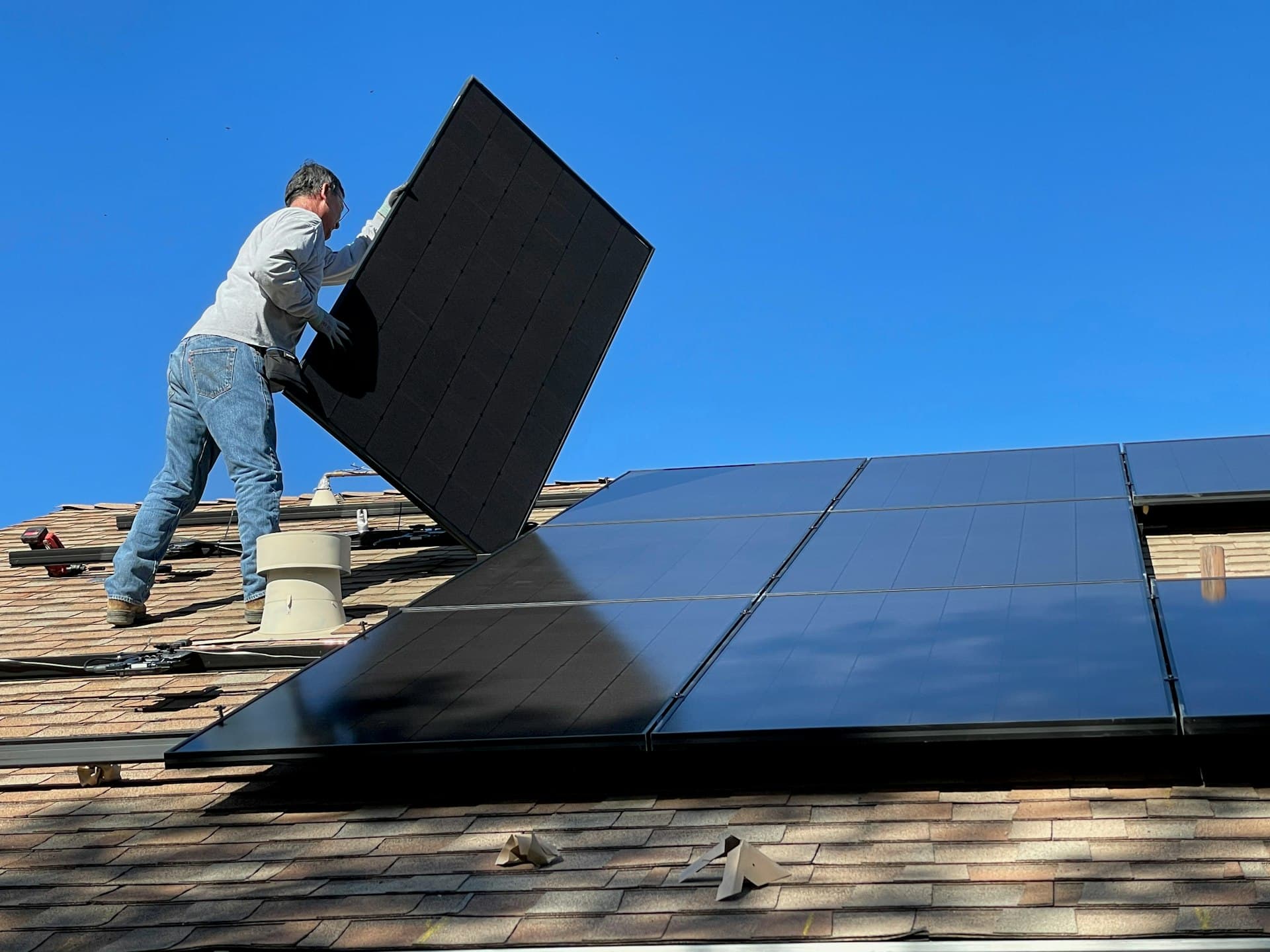
You can add solar to a RoseWater HUB later. With RoseWater’s SBX10 solar box, a HUB accepts up to 10 kW of solar input.
When solar is connected, it keeps the batteries full first and then helps feed the house. Surge and lightning protection covers the solar input as well as the main supply and any standby generator. We do not install solar ourselves. Your solar partner designs and installs the array, your licensed electrician handles the wiring, and we coordinate both with the HUB so it all works as one system. RoseWater HUBs do not accept wind power.
Is a battery without solar worth it?
A battery without solar is worth it when what you need is protection, and that describes most technology-rich homes. The value is in what stops breaking.
Without solar, a battery won’t lower your electric bill. A storage-only battery without solar also does nothing on ordinary days. An always-online system is different. It is working every hour, filling sags, absorbing surges and filtering noise before they reach the lighting control, network, theater, appliances and HVAC boards. RoseWater reports that integrators see up to 95% fewer service calls after installing HUBs. In an outage the house keeps running, and nobody has to reset anything when the grid comes back.
What does a battery system without solar look like in the house?
A battery system without solar is a cabinet in the garage or basement and a connection at the main electrical panel. Nothing goes on the roof and nothing changes outside the house.
A RoseWater HUB needs a space about 3.5 feet wide, 3 feet deep and 8 feet high, plus 36 inches clear in front for service. It does not need air conditioning. A licensed electrician makes the tie-in at the panel, and RoseWater’s technicians deliver the system to its exact spot, commission it and clean up afterward. If there is no room indoors, or the town will not allow batteries inside, the HUB40 can go outdoors in a weather-resistant, climate-controlled enclosure. More than half of RoseWater’s business is in existing homes, so a retrofit is routine.
What RoseWater does differently
Most home batteries are designed as storage for solar, with backup as a bonus. RoseWater designed the HUB the other way around. Its first job is clean, continuous power for the house. Battery storage, solar input and generator integration all serve that job.
- HUB20: 20 kW on a 100 A service, one cabinet, 28.8 kWh standard and expandable to 86.4 kWh.
- HUB40: 40 kW on a 200 A service, two cabinets, 28.8 kWh standard and expandable to 172 kWh.
- 3-Phase systems: 30, 45 or 75 kVA on 208 V three-phase service, with batteries sized per project.
Getting started
Plan around the house you have now. Our Power Plan tool asks what you want to protect, not whether you have panels. We size the HUB, coordinate your licensed electrician and RoseWater’s commissioning team, and leave room in the design for solar if you want it later. See how the options stack up on our comparison page, or ask us about your home.