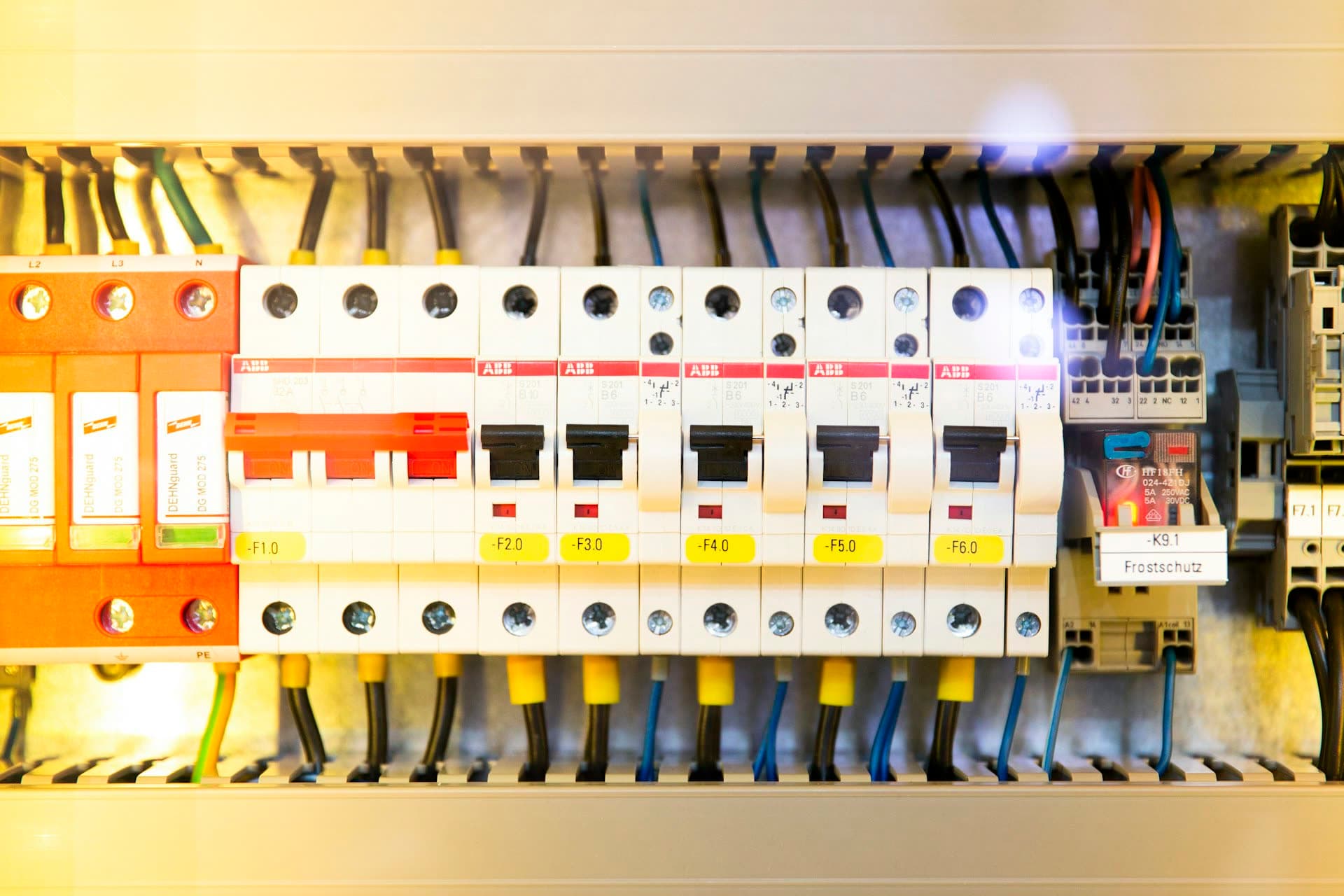
What does a whole house power conditioner do?
A whole house power conditioner fixes the electricity before your equipment uses it. It sits at the main panel and corrects problems on every circuit, instead of protecting a single rack or outlet.
That difference matters in a modern home. Rack-level conditioners protect the AV gear in one closet. The lighting control panel, the refrigerators, the HVAC boards, the steam shower controller, the motorized shades and the security system are all on other circuits. RoseWater makes the point that treating power at the panel protects lighting, appliances, HVAC, plumbing and wellness equipment, not just the AV rack.
Products sold as power conditioners do very different amounts of work. Some are surge protectors with a filter. Some regulate voltage. Only a system with stored energy can fill in a sag.
| Product type | What it handles | What it leaves out |
|---|---|---|
| Panel surge protector | Large surges and some lightning energy | Sags, noise, voltage drift, outages |
| Noise filter or choke | Some electrical noise | Sags, surges, outages |
| Voltage-regulating transformer | Slow voltage drift | Fast sags, outages, most noise |
| Rack UPS | Short outages and some conditioning for one rack | The rest of the house, and anything longer than minutes |
| RoseWater HUB | All ten problem types RoseWater lists, at the panel | Very long outages without a generator behind it |
What is dirty power?
Dirty power is any electricity that strays from a clean, steady sine wave. Utilities deliver power that is good enough for lights and motors, but it is rarely as steady as the electronics in a modern home would like.
RoseWater sorts the problems into ten categories based on IEEE definitions: blackout, frequency variation, transients, harmonics, overvoltage, undervoltage or brownout, sag, electromagnetic interference, radio frequency interference and surge. Some come from the grid. Others start inside the house, when a compressor, elevator, pool pump or dimmer puts noise back onto the wiring.
RoseWater also cites an IBM finding that a typical computer sees about 120 power problems a month, roughly four a day. Most are too short to notice. Their effect builds up.
Why do my lights flicker and my electronics reboot?
Lights flicker and electronics reboot mostly because the voltage dips for a moment. LED fixtures and their drivers react to small changes that old incandescent bulbs ignored, and microprocessors reset when the voltage drops below what they need.
These are the symptoms RoseWater owners describe before they install a HUB:
- Lights that flicker or dim for a moment
- A TV picture that almost goes dark, then recovers
- Displays or keypads that light up for no reason
- Equipment that needs rebooting more often than it should
- LED bulbs and drivers that fail early
There is one safety note. Flicker can also come from a loose connection, a failing breaker or a utility problem. If it is getting worse or is limited to one circuit, have a licensed electrician look before you think about conditioning.
Is a voltage sag worse than a surge?
A sag is often the bigger problem, because a surge protector can’t do anything about it. This is the center of RoseWater’s approach.
A surge is excess energy, and you can divert excess energy to ground. A sag is missing energy. You cannot divert power that is not there. The only way to fill a sag is to supply energy from somewhere else, which in practice means batteries that are already connected to the load.
RoseWater describes the damage from sags as “death by a thousand cuts.” A single dip rarely kills anything. Thousands of them over a few years wear down power supplies, corrupt settings and shorten the life of equipment that cost a lot to buy and more to replace once it is built into the walls.
Does a whole house power conditioner save energy?
A whole house power conditioner does not save energy, and you should be wary of one sold that way. Its job is to protect equipment.
A system that is always online uses some power to run itself. The return shows up elsewhere: fewer failed components, fewer reboots, fewer visits from your integrator after a storm, and a house that behaves the way it was designed to. RoseWater reports that integrators see up to 95% fewer service calls after installing HUBs.
What RoseWater does differently
A RoseWater HUB is always online with double conversion. Incoming power is converted and rebuilt, so the house runs on the HUB’s output all day. That output is a clean 120 V, 60 Hz sine wave with total harmonic distortion under 3%, whether the source is the grid or a generator.
- Sag correction. Each inverter module takes both AC and DC input, so batteries step in during a sag without any switch.
- Voltage regulation and noise filtering on every circuit the HUB serves.
- Surge and lightning protection that is non-sacrificial and rated for up to 40 strikes of 140,000 V.
- Optional harmonic filters, the Filter20 and Filter40, that isolate panel noise and stop cross-channel feedback.
- Zero transfer time when the grid fails, with no eco mode that drops the system out of line.
The HUB20 covers a 100 A service, the HUB40 a 200 A service, and the 3-Phase systems 208 V three-phase homes. See How It Works for the technical detail.
Where to start
Start with the systems that misbehave. Our Power Plan tool lets you mark what matters most, and we use it with your panel schedule to decide what goes on the HUB. We design the system, coordinate the tie-in with your licensed electrician and RoseWater’s commissioning team, then program and support it. If you would rather describe the symptoms first, send us a note.